Technical Performance, NRC Ratings, and Perforation Design

Acoustic metal ceiling tiles combine perforated metal faces with sound-absorbent backing materials to achieve NRC ratings from 0.65 to 0.85. The perforations don't absorb sound; they allow sound waves to pass through the metal and reach backing material where actual absorption occurs through air molecule friction and energy conversion. Understanding this mechanism, how perforation patterns affect performance, and what NRC ratings actually measure helps you specify the right system for project requirements.
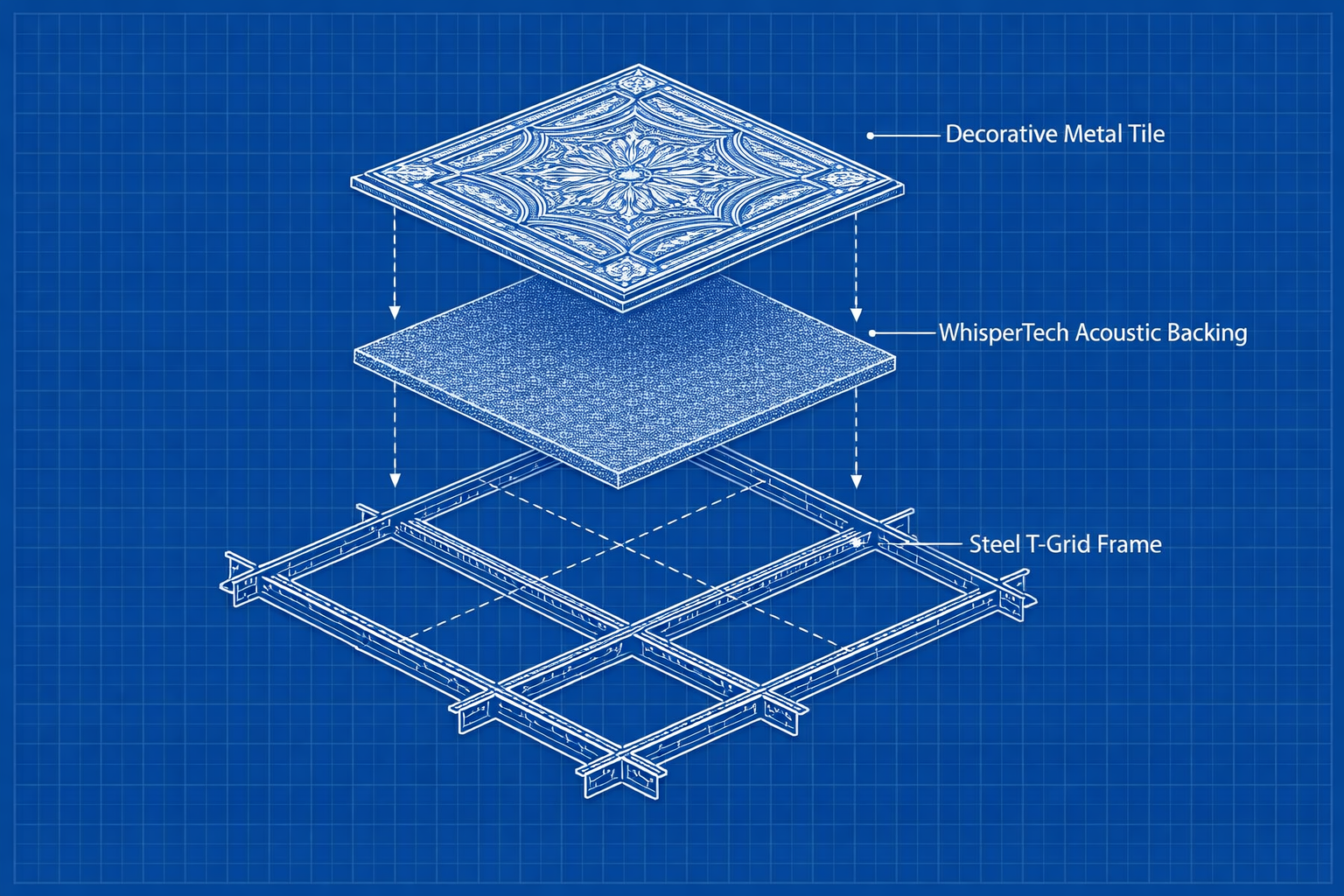
Technical diagram of acoustic ceiling tile structure with labels on a blue grid backgroundTechnical diagram of acoustic ceiling tile structure with labels on a blue grid background

Frequently Asked Questions About Acoustic Performance?

What are NRC Ratings and How Do They Work?

Noise Reduction Coefficient measures how much sound a material absorbs across frequencies most relevant to human speech (250 Hz, 500 Hz, 1000 Hz, 2000 Hz). An NRC of 0.70 means the material absorbs 70% of sound energy in this range, reflecting 30% back into the room.


NRC is calculated by averaging absorption coefficients at these four frequencies. This provides a useful single-number comparison but obscures performance variation across the frequency spectrum. Some materials absorb high frequencies effectively but struggle with low frequencies. Others show more balanced performance.


For commercial applications, balanced absorption across speech frequencies (250-2000 Hz) matters most. Shanko's QuietMetal systems achieve NRC 0.65 to 0.85 with relatively balanced performance because backing material thickness and density are optimized for speech range rather than extremely high or low frequencies.

How Do Perforation Patterns Affect Acoustic Performance?

Perforation pattern (hole size, spacing, and percentage of open area) directly affects acoustic performance. Larger perforations or higher open percentages allow more sound to reach the backing material, potentially increasing absorption. But the perforation pattern also affects structural integrity, visual appearance, and how the metal interacts with the backing material.


Standard QuietMetal perforation patterns range from 15% to 30% open area. Higher percentages generally correlate with higher NRC ratings (more sound reaches backing), but diminishing returns occur beyond certain thresholds. A 30% open pattern doesn't deliver double the performance of 15% open because backing material capacity and depth become limiting factors.


Perforation pattern also affects appearance. Smaller, more densely spaced holes create subtle texture. Larger holes create a more obvious pattern. Custom perforation patterns allow balancing acoustic requirements with design intent—you're not forced to choose between performance and aesthetics.

What Backing Materials Are Used and Why Do They Matter?

The backing material (not the metal face or perforation pattern) determines fundamental acoustic capacity. Fiberglass and mineral wool are the most common backing materials, both providing excellent sound absorption when properly specified.


Backing thickness matters significantly. Thicker backing (1.5" to 2") absorbs more sound than thinner backing (0.5" to 1"), particularly at lower frequencies. For applications requiring maximum NRC ratings, thicker backing is essential. For applications where space constraints limit backing depth, thinner backing still provides substantial improvement over bare drywall or non-acoustic ceilings.


Backing density also affects performance. Higher density backing generally provides better absorption, but installation considerations and weight become factors. Shanko specifies backing materials optimized for the combination of acoustic performance, weight, and installation practicality.

What Factors Affect Real-World Performance?

Published NRC ratings represent laboratory testing under controlled conditions. Real-world performance depends on installation details, room geometry, and how the ceiling system integrates with other surfaces.


The installation of air gaps between the metal face and backing can enhance low-frequency absorption. Proper sealing around the perimeter prevents sound flanking paths that bypass the acoustic ceiling. Integration with wall treatments, floor surfaces, and furniture all affect overall room acoustics; the ceiling is a critical component, but not the sole determinant of acoustic environment.


For noise-reduction metal ceiling tiles, understanding that published NRC ratings represent maximum potential helps set realistic expectations. Proper installation typically achieves 90-95% of laboratory performance; poor installation can significantly reduce effectiveness.

Luxurious bar with ornate ceiling and leather chairs

Application-Specific Considerations

Different applications prioritize different acoustic characteristics. Restaurants need mid-frequency absorption (conversation range) more than extreme low-frequency control. Offices benefit from balanced absorption across speech frequencies. Music venues may require custom backing specifications for a specific frequency response. 


Shanko's technical team can recommend perforation patterns and backing specifications for specific applications, balancing acoustic requirements with durability, aesthetics, and budget. The flexibility of perforated tin ceiling tiles with insulation allows customization that fiber tiles (manufactured in standardized configurations) cannot match. 

Bar with wooden counter and shelves stocked with bottles.

Need technical specifications for your project?

Contact our team for NRC test data, perforation pattern options, backing material specifications, and installation guidelines.